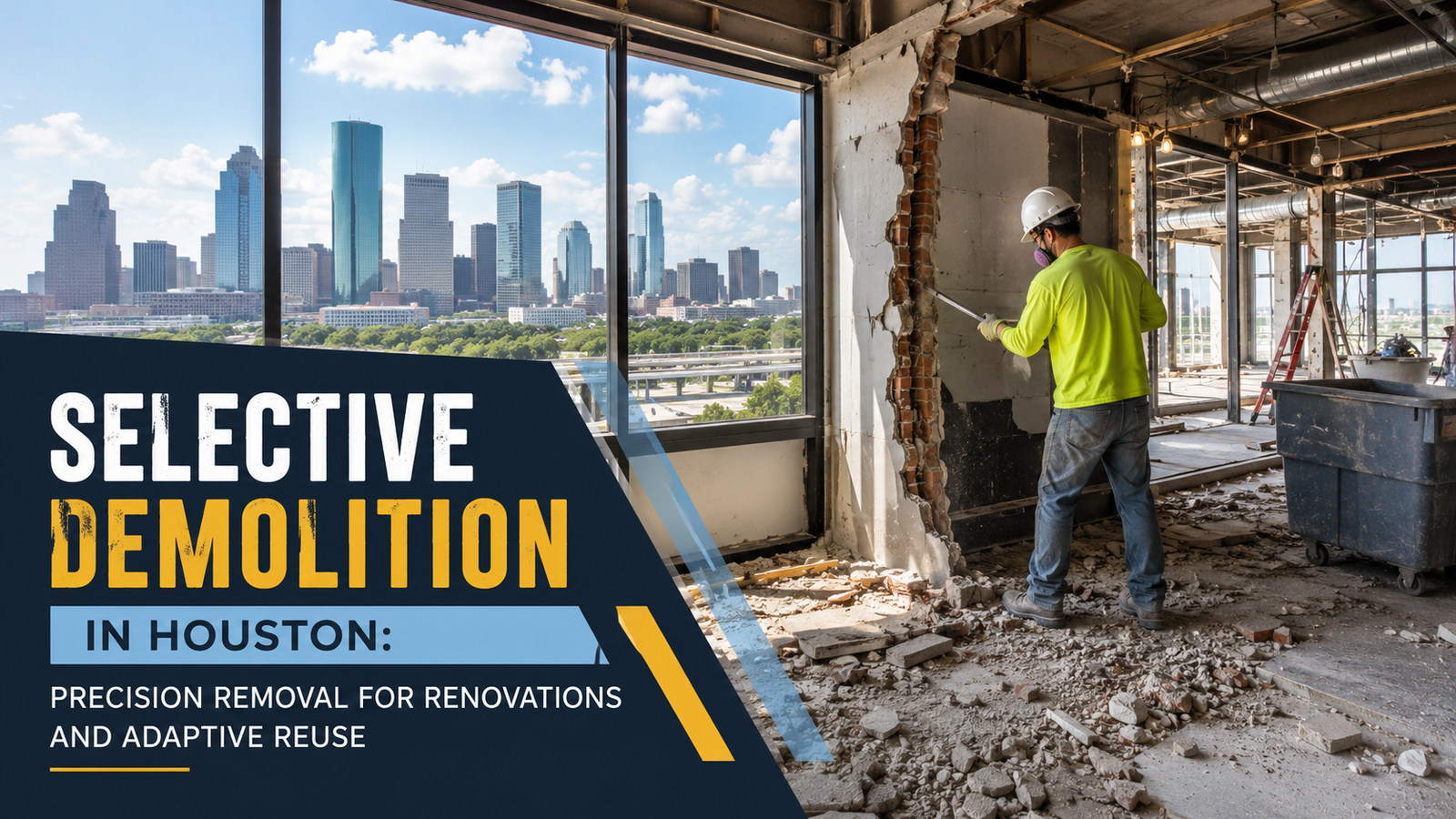
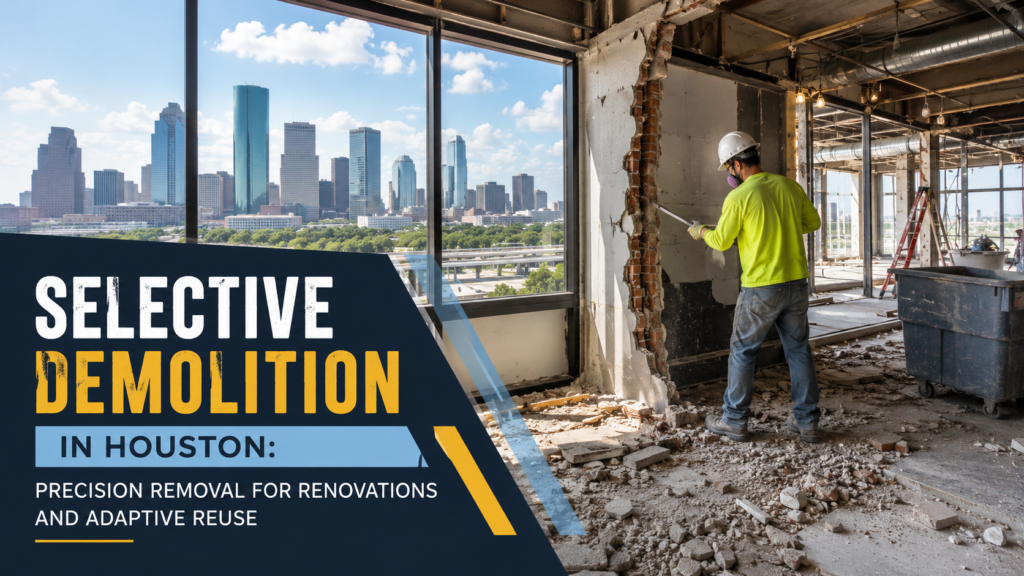
Not every demolition project in Houston involves bringing an entire building down. In many renovation, remodel, and adaptive reuse projects across the city and surrounding region, the goal is more surgical: remove specific walls, floors, mechanical systems, or interior elements while preserving and protecting everything that is to remain. This precision approach is called Selective Demolition Houston, and it represents one of the most technically demanding categories of demolition work requiring a different skill set, different tools, and a fundamentally different mindset from full-structure teardown.
What Is Selective Demolition?
Selective demolition also called precision demolition, strip-out demolition, or partial demolition is the controlled removal of specific structural or non-structural elements from a building while preserving the integrity of surrounding elements that are to remain. The defining challenge is the interface between what is being removed and what is being kept: every cut, every break, every extraction must be executed with awareness of the adjacent material that must not be damaged.
This distinguishes selective demolition fundamentally from full teardown, where the goal is efficient bulk removal. In selective work, efficiency must be balanced against precision. Large excavators that make residential teardowns fast and cost-effective are often inappropriate for interior selective demolition, where work happens in confined spaces adjacent to elements that must be preserved. Selective demolition relies heavily on hand tools reciprocating saws, oscillating multi-tools, cold chisels, pry bars, jackhammers, and concrete saws combined with smaller equipment like mini-excavators or skid steers for material handling.
Where Selective Demolition Is Used in Houston
Houston’s active commercial renovation market generates significant demand for selective demolition. When retail centers reposition tenants, when office buildings are reconfigured, when restaurants or hotels renovate, and when medical facilities upgrade their spaces, selective demolition creates the blank canvas for new construction. Interior strip-outs of commercial tenant spaces removing previous tenants’ buildout of walls, ceilings, flooring, fixtures, and mechanical systems are among the most frequently requested selective demolition scopes in the Houston market.
Houston’s industrial heritage creates another significant selective demolition market. As older industrial facilities are adapted to new uses creative office space, mixed-use development, food halls, arts venues selective demolition removes incompatible elements while preserving the building fabric that gives the space its character. Houston’s substantial stock of post-flood-event renovations where homes damaged by Harvey and subsequent events are being comprehensively rebuilt has also driven sustained demand for residential selective demolition services.
Pre-Work Planning for Selective Demolition
Effective selective demolition begins with thorough documentation and planning. Before work starts, the contractor and design team clearly establish demo limits exactly which elements are to be removed and which are to remain. Structural assessment is essential when selective demolition involves or is adjacent to load-bearing elements. In Houston’s older commercial and industrial buildings, original drawings may not be available, requiring field investigation to identify structural elements before any removal begins.
Utility isolation is a prerequisite for interior selective demolition. Electrical circuits serving the demolition zone must be properly de-energized and locked out. Water supply to fixtures in the demo area must be shut off and drained. Gas service to equipment being removed must be properly capped. Hazardous material consideration is as relevant for selective demolition as for full teardown workers cutting and grinding in older Houston structures may be exposed to asbestos or lead dust in enclosed spaces where concentrations can build up.
Protecting What Remains
The hallmark of quality selective demolition is the condition in which retained elements are left when work is complete. Protecting adjacent walls, floors, and ceilings from incidental damage requires active effort throughout the demolition process. HEPA air filtration machines, plastic sheeting containment barriers, and negative air pressure in the work zone are standard practices for enclosed interior selective demolition, particularly in occupied or partially occupied buildings.
Common Questions About Selective Demolition in Houston
Is a permit required for selective demolition in Houston? It depends on the scope. Structural modifications require building permits. Non-structural interior strip-out may not require a separate demolition permit, but the renovation work that follows typically requires permits. Confirming with the City of Houston Development Services Department is always advisable.
How is selective demolition different from full-structure demolition? Full-structure demolition uses large equipment to efficiently remove an entire building. Selective demolition uses smaller equipment and hand tools to precisely remove specific elements while protecting adjacent conditions. It is slower and more labor-intensive per square foot but essential for renovation projects where the structure must remain intact.
Can selective demolition be performed while a building is partially occupied? Yes, with appropriate precautions including work zone isolation, dust control, utility management, and careful work sequencing. Occupied selective demolition projects are common in commercial settings where business must continue during renovation.